I finally got my transcript request form in today. I made the trip to campus yesterday to turn in my remaining library books so that I could have them sign off, authorizing that I had no more debts to the University. Unfortunately, I forgot one book, the Rough Guide to Syria and Lebanon I checked out before my trip, and I had to come all the way back to campus just to turn in one book and get the library's signature. Once I accomplished this, all I had to do was turn in my request form and now I am khalaas!
The first bus leaving from campus back to Zamalek is at 12:00, and since finishing the transcript stuff took all of twelve minutes, I have some time to kill here. Hence why I am posting right now. A usual routine for me killing time at the library computer consists of a number of things. First I will check my ND gmail, then espn.com, blueandgold.com, and facebook. If I've blogged recently I will also check to see if anyone has commented. After these sites I check nytimes.com and washingtonpost.com for the day's headlines. Then I might head upstairs to the third (second) floor where the rest of my friends congregate to do homework. Going to the top floor is usually necessary since most other parts of the library get turned into social spaces between classes.
I say third (second) floor because the weird way stories on buildings are numbered here. The ground floor of each building here is called the Plaza level, and each room number starts with P, followed by a number. The second story is floor 1, with room numbers start in the 100s. Some buildings are built into the sides of hills, like a suburban house with a walk-out basement. In a building such as this, the very bottom floor, the "walk-out basement floor," is called the Garden level. The next story is the Plaza, then the third story is the first floor. So in the library, the third story up is the second floor. My friend's apartment building is even weirder. He lives on the sixth floor, which is actually 10th story of the building. When you take the elevator down from his floor (pressing the number 6 in the elevator actually takes you to story 10), you pass below floor 1 through at least six stories all labeled as floor -1 before reaching the ground floor. These bottom floors serve as shops and offices for small businesses.
*Beirut*
I don't know that I mentioned it in the first post on Beirut, but the city center has a LOT of money. We walked by a Porsche dealership and saw two Porsche Carerras and a Mazeratti just while walking down the street. We saw another sign of the amount of money in the city next to our hostel. Everyday we would walk by a travel agency advertising deals on round-trip flights for vacations in Europe or Japan or the Caribbean. But mixed within these round-trip deal were also advertisement for great one-way rates for flights out of Manilla and Columbia. Many rich families in Beirut have maids/nannies. Sonja and I saw more than a few south asians watching over young children while their wealthy Beiruti parents were either shopping or working.
Wednesday, May 27, 2009


Tuesday, May 26, 2009
Catching Up
I finished my last exam yesterday. These last few weeks have gone by extremely fast. I finally have time to catch up on all of these posts I meant to be doing but passed up on to instead pretend to study and do homework.
This past week has been pretty tough. Between doing a paper and an exam this week, I had two exams and four papers due last week. This past week I had to finish my last two assignments while dealing with the departure of many of my good friends. Some people were finished with all of their papers and exams on the last day classes and people began leaving Saturday night. Sara and Ed left Friday night, followed by Ben and Jarvis early Saturday morning. Saturday night Jim Napier and Mark left. Julia left Monday morning while I was on campus turning in an exam, and David left that night. Basically, that aren't many of us left. Most of the people who I have grown close to over the course of this semester are now gone. Its strange how close you can get to people over the course of a semester, but I suppose a study abroad experience, especially one here, forces people to let their guards down and just be themselves. Travelling, getting lost in strange citites, trying to make sense of a different culture, these things all allowed us to really get to know each other. Without getting too nostalgic, its just a little weird being in Egypt with a good portion of the people that I spent my time with here gone. Many of us became just as close to each other as to friends at home. It feels like we've known each other for years.
The study abroad experience is much like high school or college, but fast-forwarded. We all got to know each other pretty quickly, developed inside jokes, and now at the end of it all we leave and go on to other things. Mikey and Jessie go to Navy and BC, repspectively, and they are planning on coming up to ND for those football games this upcoming season. Many of our other friends live in the North East as well, so they plan on tagging along or making sure we get together when our schools play each other in Big East basketball.
Today Spencer and I went to Khan al-Kahlili again to pick up some of the last remaining items on our souveneir lists. When I went to Islamic Cairo last weekend, I wanted to pick up another taola set. I had been there the previous Wednesday and saw one that really caught my eye, but was not planning on buying anything so did not have the money. I told the guy to hold the set for me, which he said he'd do, but when I came back last weekend he had sold it. I then commissioned a set, and hopefully it will be finished by Friday. Spencer and I paid him a visit today, just to say hi. I'm not sure if I have told this story yet, but the first time I went the Khan I was very interested in finding a taola set. After looking at a number of souvenir stalls, mark and I stumbled upon a shop stuck just below ground level built into the side of a building. It appeared though this shop made the sets, among many other wooden products, themselves and then sold them through third parties throughout the rest of the bazaar.
Mark and I probably spent a good hour in there that first day, just talking to the guy and perusing his collection of hand-made woodcrafts. Which each left with a nice taola set and from that time on, this guy has been our guy for wood products. We always make sure to stop by and say hi anytime we go to the Khan.
I've been to the Khan three times in the past three weeks. I always get really excited to go because its in the heart of the old Islamic part of the city and I like looking at all the shiny trinkets. I always leave with a headache, wondering why I was so excited to go in the first place. A trip to the bazaar takes a lot out of you. Its impossible to just walk and look, and windowshopping is always a hassle. The stall owners all interprety looking at a product or handling a product as a sign of general interest in purchasing the product. When they give you a price, unsolicited, there is always a disconnect when answering "I don't want it." They always think you don't want it because their price is too high, so they lower it. They don't understand that often the price is not the problem; the problem is that you simply don't want to buy that item.
Besides this, all the item-hawkers are pretty pushy, and haggling takes a lot of energy, especially if you want to get a good price. Anything can be obtained cheaply, but there is a standard theatere one must "perform" to make haggling work. First you have to absurdly low-ball the guy, then work your way back up to a normal range of prices. This low-balling counteracts his ridiculous mark-up, placing summer in the middle of that range the actual price you want. He'll usually come down to within a couple increments of the price you want, whether you're working in 5's or 10's or whatever. At some point he will give his so-called "best price," usually an increment or two or three above what you really want. You then restate what you want it for, he says no, and you walk away. He may call you back right away or he may let you walk a bit before catching you and bringing the price down again. You can usually walk away twice, sometimes three times, and get the price lowered further. Now you have a good price! Then you realize that you just spend the last ten minutes arguing over a 5LE difference, which amounts to $1.75. Then you feel like an idiot. Anyway, I went to the Khan the last two weekends because I was touring Islamic Cairo, where the Khan is locate. This is the oldest Islamic part of the city.
Two weekends ago Sara, Ed, and Sophie came along with me to Islamic Cairo. We only made a half day of it so we covered the northern end. The cab dropped us off near al-Azhar mosque and university and we began our tour here. As is usual in mosques, we had to take off our shoes and Sara and Sophie had to cover their heads with their scarves. Al-Azhar University is the world center of Sunni Islamic learning and is also a very important mosque. From here we continued to the al-Ghouriya mosque, a Mamluk era mosque at the head of the southern market. One time when we were in this area a guy pointed us back north, saying "There Khank al-Khalili, this not the tourist market." Egypt is frustrating at times. Very often we know what we are doing and where we are and have to put up with people trying to point is in the direction we are already going or trying to lead us to some touristy site we are totally uninterested in. Anyway, we continuted south down this street, Al-Muizz li Din Allah, until reaching Bab Zuwayla. This is an old medieval-era gate, complete with towers and parapets and giant wooden doors. We climbed the tower, which required some athleticism at the top, and got a wonderful view of Islamic Cairo. We could see north to Al-Azhar and south to the Citadel.
Sophie and Sara stopped in the market to buy some of the colorfully patterned cloth used for decoration in Egypt. After this we walked back north past Al-Azhar and followed the street through Khan al-Khalili. We stopped at the mausoleum and madrassa of Al Nasir Muhammad and of Sultan Qalawun, then continued north to the mosque of Al-Hakim, the Caliph of the Fatimid Empire who proclaimed divinity for himself and whose heterodox religious teachings helped foudn the Druze faith. We then finished our day at the medieval gate of Bab al-Futuh, counterpart of Bab Zuawayla. This all occurred three weekends ago, so I'm hazy on the details still unfortunately...
Last weekend I tagged along on Jessie and Julia's Islamic Art and Architecture field trip to the citadel. I had not toured any of Islamic Cairo at that point and needed to fit it in before leaving. The fieldtrip was a great opportunity because I got into the complex for free and their professor's lectures at each site essentially amounted to a free tour for me. She also got us access to some places tourists couldn't normally go. It was also a good opportunity because all of my other friends here had already gone earlier in the semester. The field trip kind of ensured that there would be people to come tour with me. Spencer and Jim came too, because they never made it this far when they came to Islamic Cairo. They were accused of being Jews by an old hagg and watched her chew out the guy who had let them into a mosque. They called it at day after that. So Spencer, Jim, and I walked the half-mile to the mosque of Ahmad ibn Tulun, the oldest mosque in Cairo. Its doors opened in 876. Disappointingly, I left my Egypt guidebook behind this day. I knew where I wanted to go and how to get there, so I saw no sense in taking along anything other than a street map. Had a brought the book, I would have known that we missed the best part of going to ibn-Tulun mosque: the adjacent 16th century house-turned-museum. The book calls it an Orientalist's fantasy almost more worth seeing than the mosque itself, complete with intricate artwork, secret viewing galleries, porticos looking over open courtyards with fountains, and winding passageways. We also passed up the worth-while Museum of Islamic Art due to time constraints. I didn't sense much interest in going there anyway (as I said, being in this area for too long, including the Khan which we were headed to next, makes for a very long day). Perhaps I will go back to these places in these last three full days I have here. The mosque was impressive considering the time period in which it was built and the fact that Christians were still a vast majority in Egypt at the time of its construction.
We cabbed from ibn-Tulun to Midan al-Hussein, the starting point for all of our ventures into Khan al-Kahlili. Spencer and Jim had not been to Al-Azhar yet, so we stopped here one more time. Then I showed them how to get to a book-binding store Mark, Mikey, and I had found the preceding Wednesday. They sell leather- and cloth-bound books and custom engrave them with gold leafing. Thus began another tiring day in Khan al-Khalili. It was these day that I found out our friend in the woodshop had sold the taola that I promised him I would return for. He apologized, saying the guy gave him a very generous offer. Oh well.
I have three more days here and lots of packing to do. I hope to see some of these last few things on my list before leaving, never knowing when or if I will ever return. Well I guess that last statement was a little dramatic but I probably won't be back for a while and I don't want to leave with any regrets.
This past week has been pretty tough. Between doing a paper and an exam this week, I had two exams and four papers due last week. This past week I had to finish my last two assignments while dealing with the departure of many of my good friends. Some people were finished with all of their papers and exams on the last day classes and people began leaving Saturday night. Sara and Ed left Friday night, followed by Ben and Jarvis early Saturday morning. Saturday night Jim Napier and Mark left. Julia left Monday morning while I was on campus turning in an exam, and David left that night. Basically, that aren't many of us left. Most of the people who I have grown close to over the course of this semester are now gone. Its strange how close you can get to people over the course of a semester, but I suppose a study abroad experience, especially one here, forces people to let their guards down and just be themselves. Travelling, getting lost in strange citites, trying to make sense of a different culture, these things all allowed us to really get to know each other. Without getting too nostalgic, its just a little weird being in Egypt with a good portion of the people that I spent my time with here gone. Many of us became just as close to each other as to friends at home. It feels like we've known each other for years.
The study abroad experience is much like high school or college, but fast-forwarded. We all got to know each other pretty quickly, developed inside jokes, and now at the end of it all we leave and go on to other things. Mikey and Jessie go to Navy and BC, repspectively, and they are planning on coming up to ND for those football games this upcoming season. Many of our other friends live in the North East as well, so they plan on tagging along or making sure we get together when our schools play each other in Big East basketball.
Today Spencer and I went to Khan al-Kahlili again to pick up some of the last remaining items on our souveneir lists. When I went to Islamic Cairo last weekend, I wanted to pick up another taola set. I had been there the previous Wednesday and saw one that really caught my eye, but was not planning on buying anything so did not have the money. I told the guy to hold the set for me, which he said he'd do, but when I came back last weekend he had sold it. I then commissioned a set, and hopefully it will be finished by Friday. Spencer and I paid him a visit today, just to say hi. I'm not sure if I have told this story yet, but the first time I went the Khan I was very interested in finding a taola set. After looking at a number of souvenir stalls, mark and I stumbled upon a shop stuck just below ground level built into the side of a building. It appeared though this shop made the sets, among many other wooden products, themselves and then sold them through third parties throughout the rest of the bazaar.
Mark and I probably spent a good hour in there that first day, just talking to the guy and perusing his collection of hand-made woodcrafts. Which each left with a nice taola set and from that time on, this guy has been our guy for wood products. We always make sure to stop by and say hi anytime we go to the Khan.
I've been to the Khan three times in the past three weeks. I always get really excited to go because its in the heart of the old Islamic part of the city and I like looking at all the shiny trinkets. I always leave with a headache, wondering why I was so excited to go in the first place. A trip to the bazaar takes a lot out of you. Its impossible to just walk and look, and windowshopping is always a hassle. The stall owners all interprety looking at a product or handling a product as a sign of general interest in purchasing the product. When they give you a price, unsolicited, there is always a disconnect when answering "I don't want it." They always think you don't want it because their price is too high, so they lower it. They don't understand that often the price is not the problem; the problem is that you simply don't want to buy that item.
Besides this, all the item-hawkers are pretty pushy, and haggling takes a lot of energy, especially if you want to get a good price. Anything can be obtained cheaply, but there is a standard theatere one must "perform" to make haggling work. First you have to absurdly low-ball the guy, then work your way back up to a normal range of prices. This low-balling counteracts his ridiculous mark-up, placing summer in the middle of that range the actual price you want. He'll usually come down to within a couple increments of the price you want, whether you're working in 5's or 10's or whatever. At some point he will give his so-called "best price," usually an increment or two or three above what you really want. You then restate what you want it for, he says no, and you walk away. He may call you back right away or he may let you walk a bit before catching you and bringing the price down again. You can usually walk away twice, sometimes three times, and get the price lowered further. Now you have a good price! Then you realize that you just spend the last ten minutes arguing over a 5LE difference, which amounts to $1.75. Then you feel like an idiot. Anyway, I went to the Khan the last two weekends because I was touring Islamic Cairo, where the Khan is locate. This is the oldest Islamic part of the city.
Two weekends ago Sara, Ed, and Sophie came along with me to Islamic Cairo. We only made a half day of it so we covered the northern end. The cab dropped us off near al-Azhar mosque and university and we began our tour here. As is usual in mosques, we had to take off our shoes and Sara and Sophie had to cover their heads with their scarves. Al-Azhar University is the world center of Sunni Islamic learning and is also a very important mosque. From here we continued to the al-Ghouriya mosque, a Mamluk era mosque at the head of the southern market. One time when we were in this area a guy pointed us back north, saying "There Khank al-Khalili, this not the tourist market." Egypt is frustrating at times. Very often we know what we are doing and where we are and have to put up with people trying to point is in the direction we are already going or trying to lead us to some touristy site we are totally uninterested in. Anyway, we continuted south down this street, Al-Muizz li Din Allah, until reaching Bab Zuwayla. This is an old medieval-era gate, complete with towers and parapets and giant wooden doors. We climbed the tower, which required some athleticism at the top, and got a wonderful view of Islamic Cairo. We could see north to Al-Azhar and south to the Citadel.
Sophie and Sara stopped in the market to buy some of the colorfully patterned cloth used for decoration in Egypt. After this we walked back north past Al-Azhar and followed the street through Khan al-Khalili. We stopped at the mausoleum and madrassa of Al Nasir Muhammad and of Sultan Qalawun, then continued north to the mosque of Al-Hakim, the Caliph of the Fatimid Empire who proclaimed divinity for himself and whose heterodox religious teachings helped foudn the Druze faith. We then finished our day at the medieval gate of Bab al-Futuh, counterpart of Bab Zuawayla. This all occurred three weekends ago, so I'm hazy on the details still unfortunately...
Last weekend I tagged along on Jessie and Julia's Islamic Art and Architecture field trip to the citadel. I had not toured any of Islamic Cairo at that point and needed to fit it in before leaving. The fieldtrip was a great opportunity because I got into the complex for free and their professor's lectures at each site essentially amounted to a free tour for me. She also got us access to some places tourists couldn't normally go. It was also a good opportunity because all of my other friends here had already gone earlier in the semester. The field trip kind of ensured that there would be people to come tour with me. Spencer and Jim came too, because they never made it this far when they came to Islamic Cairo. They were accused of being Jews by an old hagg and watched her chew out the guy who had let them into a mosque. They called it at day after that. So Spencer, Jim, and I walked the half-mile to the mosque of Ahmad ibn Tulun, the oldest mosque in Cairo. Its doors opened in 876. Disappointingly, I left my Egypt guidebook behind this day. I knew where I wanted to go and how to get there, so I saw no sense in taking along anything other than a street map. Had a brought the book, I would have known that we missed the best part of going to ibn-Tulun mosque: the adjacent 16th century house-turned-museum. The book calls it an Orientalist's fantasy almost more worth seeing than the mosque itself, complete with intricate artwork, secret viewing galleries, porticos looking over open courtyards with fountains, and winding passageways. We also passed up the worth-while Museum of Islamic Art due to time constraints. I didn't sense much interest in going there anyway (as I said, being in this area for too long, including the Khan which we were headed to next, makes for a very long day). Perhaps I will go back to these places in these last three full days I have here. The mosque was impressive considering the time period in which it was built and the fact that Christians were still a vast majority in Egypt at the time of its construction.
We cabbed from ibn-Tulun to Midan al-Hussein, the starting point for all of our ventures into Khan al-Kahlili. Spencer and Jim had not been to Al-Azhar yet, so we stopped here one more time. Then I showed them how to get to a book-binding store Mark, Mikey, and I had found the preceding Wednesday. They sell leather- and cloth-bound books and custom engrave them with gold leafing. Thus began another tiring day in Khan al-Khalili. It was these day that I found out our friend in the woodshop had sold the taola that I promised him I would return for. He apologized, saying the guy gave him a very generous offer. Oh well.
I have three more days here and lots of packing to do. I hope to see some of these last few things on my list before leaving, never knowing when or if I will ever return. Well I guess that last statement was a little dramatic but I probably won't be back for a while and I don't want to leave with any regrets.
Saturday, May 16, 2009
Lebanon
I've been real busy with school lately so I havn't been updating the blog as much as I would like, but here I will hopefully be able to fill everybody in on the last real exciting weekend trip of the semester. This focus on the major events is coming at the expense of some of the less immediately impressive trips and incidents in Cairo, which is a shame because I think these paint a good picture of eveyday life here. Hopefully I will remember enough about them to set out the details later.
As noted earlier, Sonja and I had intended to go to Lebanon the weekend after springbreak. Unfortunately, we missed our flight at had to move the trip back one weekend. This time we arrived at the airport well in advance of our flight. Here we picked up some cheap Cuban cigars at the Duty Free store for the simple novelty of having them, since the US obviously still has a trade embargo on Cuba.
The flight was short, barely over an hour, and we arrived in Beirut around 8pm. I was unsure as to what line to get in at customs because no one was working the passport booth selling Lebanese visas. I asked an official where I needed to go to get my visa and he asked me my nationality. I said American, and he responded, "You can stand wherever you like." Americans are positiviely racially profiled in much of the region, sometimes to ironic results. For example, today I went to Midan (Square) Husayn in Islamic Cairo and they had stepped up security since the minor bombing back in February. We were waiting in line while they were checking everyone's bags, but they just waved me, Spencer, and Jim through since we were white tourists, and hence obviously not a threat. Mikey commented on this when we were down there last week, finding it funny how the Egyptian security forces negatively racially profiled their own citizens.
Once through customs, we changed our money into Lebanese Lira (1500 to $1) and grabbed a cab to the American University in Beirut Hostel. The cab charged us an exorbitant fare and we later found out that a cartel runs the cab services from the airport. People have been charged up to $100, but we managed to get the "low" price of $56. This was a shock coming from Cairo where a cab ride from the airport costs 50LE (under $10).
The AUB Hostel was simple and clean and conveniently located just across the street from the main gates of AUB in the heart of West Beirut. We were a little overwhelmed the first night in Beirut. We could handle impoverished, third-world type stuff, but Beirut was modern, bright, clean. It reminded me a lot of Charleston. It was just a brand new city very unlike the one in which I am used to living. Sonja has a friend she met at an academic conference over the summer who works at a TV station on Lebanon's most-watched nightly news program. We met up with him for dinner and let him drives around the city. We felt much better after this. It helped us get oriented with the city and let us know that we had somebody we could call if we needed anything.
Most interesting about this car ride was that Philipe (Sonja's friend) was working his phone in order to get guests for the next days show. But these weren't just any guests; they were the four generals that had just been released from prison that day, arrested for alleged complicity in the assasination of president Rafik Hairi in 2005. We listened in as he called his connections, looking for people who had any way of contacting these generals and getting them on his show. He found the number for one of the general's homes or his wife's cell-phone (I don't know which, I recall only that his wife answered) and put the call on speaker, and we listened as he spoke the general and he agreed to join the next day's show.
In these phone calls, Philipe used a mixture of Arabic, English, and French. This is common throughout much of Lebanon. On all of my previous flights on Egypt air, the safety instructions and cabin announcements were made in both Arabic and Englihs. Only on the flight to Lebanon was French added to this list. The French held Lebanon and Syria as imperial posessions (under the mandate guise) for much of the early twentieth century. The French language has been preserved there since that time. English has now also made its impact. Almost all of Lebanon's upper classes know French, as do the educated youth. The wealthy youth also seem to have a pretty international orientation. We went to a bar one night that reminded me more of a coffeehouse than a pub. It had comfy chairs and shelves full of books, and on the wall an old black and white French film whose main character was involved in mobilizing the laboring classes was being projected. They played a mixture of Arabic, French, and English pop, and while many Egyptian youth try to replicate American and European culture and styles, the Lebanese youth seemed be buying into an authentic copy and rather than cheap imitations here in Cairo.
The first morning we took a cab to Daorra, on the north side of the city I'm assuming, and from there hopped on the bus to Tripoli. The ride took longer than expected because it wasn't direct and stopped frequently, letting people on and off, until we made it out of the city and through the hills over to Tripoli. Tripoli is a fascinating city historically because of the number of different rulers it has had. The area has been controlled by the Ummayed Empire, the Crusaders, the Mamluks, the Ottomans, the French, and now the Lebanese themselves. A number of the mosques we toured there were built originally as churches and had switched denominations multiple times depending on the changing rulers and demographics until finally becoming mosques.
As soon as we stepped off the bus we were met by an old Tripolian offering to show us around. He had maps and said he was from the Tripoli tourism department. He seemed believable but we are generally pretty wary of people in Egypt, especailly the extremely forward ones, and we carried this attitude over to Lebanon. We had him direct us to a good restaurant and declined his invitation for a guided tour. We decided we could find our way around just fine.
Most of the historically interesting sites in Tripoli are in the Medieval section, making a map almost useless since the streets and alleyways are haphazardly laid out often not even named. However, our first stop was the citadel, which was easy to spot on the hill overlooking the streets below. We found our way up to it and got some great views of the city. We were the only two tourists there until the very end, when two more people showed up. A row of armored Lebanese army vehicles were parked outside the main entrance and there were officers posted throughout the complex. We found no guides or information plaques on the inside, so all I really know about the citadel is that its a castle-looking thing that has a canon on its roof somewhere. And it is presumably centuries old. I'm sure I could look up the information somewhere but that would just take too much effort, wouldn't it?
Leaving the citadel was when the adventure began. The rest of our sites were located in the city below where street names and maps were painfully unhelpful. We wandered around looking for the Great Mosque for twenty minutes when the map showed it being right next to the citadel.. As it turns out, we had walked past it twice. The problem was that its name made it sound a lot greater in appearance than it actually was and we reasoned that the small mosque we kept passing was obviously not the "Great Mosque." While trying to find this mosque we ran into our friend from the bus stop again. Realizing how difficult (and uniformative) it would be getting around Tripoli on our own, we decided to give him a chance. This turned out to be the best part of the trip.
I forget the man's name, but he is listed in the latest Lonely Planet edition for Lebanon. As it turns out he (by his own claim) is the best and most famous tour guide in Tripoli. Just the weekk before he had given a tour to some city offiicial of Venice, Italy. To prove his point, he showed us four business cards left to him by some of his more prominent clients. Today was our lucky day, because we were getting a free tour. It used to be that you would have to call days in advance to schedule a tour with him, but after 9/11 tourism to Lebanon was cut in half. After Hezbollah's increased activity in 2006, tourism was halved again. Instead, he was now staking out the bus stop praying for tourists to show just so he could have somebody to show around. Today we had a free tour for as long as we wanted. He took a lot of pride in his city and just wanted the chance to show it off. I think he was just excited to have some work, especially from Americans, who I'm sure he doesn't get much of a chance to give tours to these days.
 Tripoli from the top of the Citadel
 Ads for the elections in June
 One of the many churhc-turned-mosuqe-turned-church-turned mosques
 Proof that the soap was hand made
 Sonja in one of the shops making modern use of an old building

 The Mediterranean and Beiruti suburbs on the hills behind it
 The brand new mosque, viewed from a church near the new square
As noted earlier, Sonja and I had intended to go to Lebanon the weekend after springbreak. Unfortunately, we missed our flight at had to move the trip back one weekend. This time we arrived at the airport well in advance of our flight. Here we picked up some cheap Cuban cigars at the Duty Free store for the simple novelty of having them, since the US obviously still has a trade embargo on Cuba.
The flight was short, barely over an hour, and we arrived in Beirut around 8pm. I was unsure as to what line to get in at customs because no one was working the passport booth selling Lebanese visas. I asked an official where I needed to go to get my visa and he asked me my nationality. I said American, and he responded, "You can stand wherever you like." Americans are positiviely racially profiled in much of the region, sometimes to ironic results. For example, today I went to Midan (Square) Husayn in Islamic Cairo and they had stepped up security since the minor bombing back in February. We were waiting in line while they were checking everyone's bags, but they just waved me, Spencer, and Jim through since we were white tourists, and hence obviously not a threat. Mikey commented on this when we were down there last week, finding it funny how the Egyptian security forces negatively racially profiled their own citizens.
Once through customs, we changed our money into Lebanese Lira (1500 to $1) and grabbed a cab to the American University in Beirut Hostel. The cab charged us an exorbitant fare and we later found out that a cartel runs the cab services from the airport. People have been charged up to $100, but we managed to get the "low" price of $56. This was a shock coming from Cairo where a cab ride from the airport costs 50LE (under $10).
The AUB Hostel was simple and clean and conveniently located just across the street from the main gates of AUB in the heart of West Beirut. We were a little overwhelmed the first night in Beirut. We could handle impoverished, third-world type stuff, but Beirut was modern, bright, clean. It reminded me a lot of Charleston. It was just a brand new city very unlike the one in which I am used to living. Sonja has a friend she met at an academic conference over the summer who works at a TV station on Lebanon's most-watched nightly news program. We met up with him for dinner and let him drives around the city. We felt much better after this. It helped us get oriented with the city and let us know that we had somebody we could call if we needed anything.
Most interesting about this car ride was that Philipe (Sonja's friend) was working his phone in order to get guests for the next days show. But these weren't just any guests; they were the four generals that had just been released from prison that day, arrested for alleged complicity in the assasination of president Rafik Hairi in 2005. We listened in as he called his connections, looking for people who had any way of contacting these generals and getting them on his show. He found the number for one of the general's homes or his wife's cell-phone (I don't know which, I recall only that his wife answered) and put the call on speaker, and we listened as he spoke the general and he agreed to join the next day's show.
In these phone calls, Philipe used a mixture of Arabic, English, and French. This is common throughout much of Lebanon. On all of my previous flights on Egypt air, the safety instructions and cabin announcements were made in both Arabic and Englihs. Only on the flight to Lebanon was French added to this list. The French held Lebanon and Syria as imperial posessions (under the mandate guise) for much of the early twentieth century. The French language has been preserved there since that time. English has now also made its impact. Almost all of Lebanon's upper classes know French, as do the educated youth. The wealthy youth also seem to have a pretty international orientation. We went to a bar one night that reminded me more of a coffeehouse than a pub. It had comfy chairs and shelves full of books, and on the wall an old black and white French film whose main character was involved in mobilizing the laboring classes was being projected. They played a mixture of Arabic, French, and English pop, and while many Egyptian youth try to replicate American and European culture and styles, the Lebanese youth seemed be buying into an authentic copy and rather than cheap imitations here in Cairo.
The first morning we took a cab to Daorra, on the north side of the city I'm assuming, and from there hopped on the bus to Tripoli. The ride took longer than expected because it wasn't direct and stopped frequently, letting people on and off, until we made it out of the city and through the hills over to Tripoli. Tripoli is a fascinating city historically because of the number of different rulers it has had. The area has been controlled by the Ummayed Empire, the Crusaders, the Mamluks, the Ottomans, the French, and now the Lebanese themselves. A number of the mosques we toured there were built originally as churches and had switched denominations multiple times depending on the changing rulers and demographics until finally becoming mosques.
As soon as we stepped off the bus we were met by an old Tripolian offering to show us around. He had maps and said he was from the Tripoli tourism department. He seemed believable but we are generally pretty wary of people in Egypt, especailly the extremely forward ones, and we carried this attitude over to Lebanon. We had him direct us to a good restaurant and declined his invitation for a guided tour. We decided we could find our way around just fine.
Most of the historically interesting sites in Tripoli are in the Medieval section, making a map almost useless since the streets and alleyways are haphazardly laid out often not even named. However, our first stop was the citadel, which was easy to spot on the hill overlooking the streets below. We found our way up to it and got some great views of the city. We were the only two tourists there until the very end, when two more people showed up. A row of armored Lebanese army vehicles were parked outside the main entrance and there were officers posted throughout the complex. We found no guides or information plaques on the inside, so all I really know about the citadel is that its a castle-looking thing that has a canon on its roof somewhere. And it is presumably centuries old. I'm sure I could look up the information somewhere but that would just take too much effort, wouldn't it?
Leaving the citadel was when the adventure began. The rest of our sites were located in the city below where street names and maps were painfully unhelpful. We wandered around looking for the Great Mosque for twenty minutes when the map showed it being right next to the citadel.. As it turns out, we had walked past it twice. The problem was that its name made it sound a lot greater in appearance than it actually was and we reasoned that the small mosque we kept passing was obviously not the "Great Mosque." While trying to find this mosque we ran into our friend from the bus stop again. Realizing how difficult (and uniformative) it would be getting around Tripoli on our own, we decided to give him a chance. This turned out to be the best part of the trip.
I forget the man's name, but he is listed in the latest Lonely Planet edition for Lebanon. As it turns out he (by his own claim) is the best and most famous tour guide in Tripoli. Just the weekk before he had given a tour to some city offiicial of Venice, Italy. To prove his point, he showed us four business cards left to him by some of his more prominent clients. Today was our lucky day, because we were getting a free tour. It used to be that you would have to call days in advance to schedule a tour with him, but after 9/11 tourism to Lebanon was cut in half. After Hezbollah's increased activity in 2006, tourism was halved again. Instead, he was now staking out the bus stop praying for tourists to show just so he could have somebody to show around. Today we had a free tour for as long as we wanted. He took a lot of pride in his city and just wanted the chance to show it off. I think he was just excited to have some work, especially from Americans, who I'm sure he doesn't get much of a chance to give tours to these days.
Tripoli from the top of the CitadelAds for the elections in JuneHe was wonderful because he helped us get to all the sites we wanted, gave us lots of information on them, and got us into places we never would have been willing or able to enter. At the great mosque he got us access to the hall they were refurbishing, which was supposed to be kept closed to all until its grand reoppening the next month. After this we went to two madrassas (means both school and religious school) and their adjoining mosques. Now you can normally tour most mosques, especially those listed on tourist maps as these were. But this is much easier in Cairo where you are one among 20 or 30 other tourists. In Tripoli, we were the only tourists at these mosques making it a little more awkward. We would have most likely felt too uncomfortable walking around a holy place taking pictures among praying people had we not been accompanied by this well-respected tour guide.
One of the many churhc-turned-mosuqe-turned-church-turned mosquesProof that the soap was hand made Sonja in one of the shops making modern use of an old building In addition to these buildings, he helped us navigate Tripoli's famous souks and took us to the second floor of an old caravanasa where a man operates a shop hand-making and carving olive oil soap. On one of the pillars was an intricately carved Star of David. Our guide emphasized the religious diversity of Tripoli (and Lebanon). He said that Jews should be just as welcome as Christians and Muslims and confessed that his personal beliefs borrowed aspects of all three religious categories. He mentioned the Hezbollah "victory" in Tripoli in 2006, and said that this was no victory at all. They claim they are fighting on behalf of the people but they only divide. He cited the mass exodus of Americans, at the behest of the State Department, following Hezbollah's disturbances in 2006.
Sonja in the reataurant in which we ended our day in Beirut
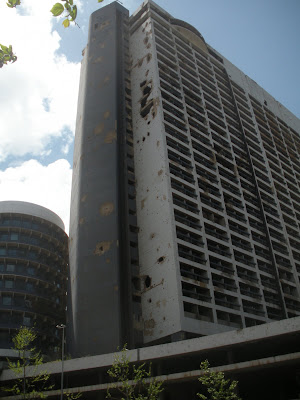
The day in Tripoli ended at a great Lebanese restuarant. We then caught the bus back to Beirut and took it easy for the night. We had heard that Beirut had incredible night life but we were pretty tired and instead made it an early night. The next day we spent walking around the city of Beirut. After leaving the hostel we made our way to the corniche and walked along the mediterranean until turning back into the city to find the tourist information center. This turned out be more difficult to find than we expected, but we got a good chance to walk around Soldiere. Soldiere is a section central Beirut that was reduced to rubble during the 1975-1990 civil war. The city has initiated a massive redevelopment project to rebuild this section, and today it is almost completely filled with modern glass and steel high rises. Every now and then though we could spot a few buildings yet to be restored. Before we had reached soldiere we passed the blown out skeleton the St. George Hotel and the building facing it across the street. This is where president Rafik Hariri was assasinated in 2005. In the soldiere district we also saw the remains of a church. Some of the older stone building, like churches, still bore the marks of the civil war. A very strong polic/military presence was maintained within this district. They also highly discouraged the taking of pictures. Perhaps they wanted people to get over their violent past, or maybe they felt that if every tourist came back only with picures of building with bullet holes would misrepresent the city. Either way, we'll see whether Beirut, and Lebanon, can keep its past behind it in the upcoming June elections.
The Mediterranean and Beiruti suburbs on the hills behind itBlast damage from the bomb that killed Rafik Hariri. His son's party would win the June elections.
The brand new mosque, viewed from a church near the new squareWe had lunch in an upscale, brand new square near this area. In the center is a stone clocktower and the streets that intersect at this square are lined with outdoor cafes and shops. We then walked from here to a Bay Rock Cafe, a cafe on the west side of the city overlooking the Mediterranean and Pigeon Rocks, two famous rock formations with arches carved through their bases. We rested back at the hostel and managed to make it out that night. This is when we found the bar I was speaking about earlier. East Beirut is supposed to have great clubs, but niether of us were exactly in a clubbing mood and the cab and cover likely would have been pretty expensive.
On our the next and final day we cabbed over to the Musee National de Beyruth (National Museum of Beirut). The place was fascinating. It had Phoenician, Greek, Roman, Byzantine, Islamic, Crusader, Mamluk, and Ottoman artifacts. One of the most interesting parts was a movie about the museum during the war. The small artifacts were all evacuated and the more immobile ones were cased in concrete boxes. It detailed the damage the building experienced during the war and showed the reopening of the concrete boxes. Inside the musuem was also a melted concoction of rock, glass, and metal. This was what the intense heat caused by fires in the museum during the war turned an artifcat into. The day ended back in the same square we were in the previous day. We got lunch and some last-minute souveneirs and then walked back to the AUB hostel. There we picked up our bags and cabbed to the airport. Along the way we saw a number of signs advertising Hezbollah for the upcoming elections. We arrived back in Cairo around 11pm, just in time to do my homework for the weekend.
Just for fun, an excerpt from the State Department travel warning regarding Lebanon, updated two weeks after our trip:
"May 13, 2009
The Department of State continues to urge U.S. citizens to avoid all travel to Lebanon due to current safety and security concerns. Americans presently living and working in Lebanon should understand that they accept risks in remaining and should carefully consider those risks. This supersedes the Travel Warning issued on September 10, 2008 and updates information on security threats and ongoing political violence in Lebanon.
While Lebanon enjoys periods of relative calm, the potential for a spontaneous upsurge in violence is real. Lebanese government authorities are not able to guarantee protection for citizens or visitors to the country should violence erupt suddenly. U.S. Embassy personnel practice strict security precautions at all times. Access to borders and ports can be interrupted with little or no warning. Under such circumstances, travel of U.S. Embassy personnel would likely be restricted further, hindering their ability to reach travelers or provide emergency services.
Clashes in the northern city of Tripoli in 2008 resulted in more than twenty fatalities and numerous injuries. Additionally, a bomb exploded next to a city bus in Tripoli on August 13, 2008, killing fourteen people. The U.S. Embassy recommends that U.S. citizens in Tripoli consider these risks in light of past events.
On May 7, 2008, Hizballah militants blocked the road to Rafiq Hariri International Airport. The action rendered the airport inaccessible and travelers were unable to enter or leave the country via commercial air carriers. Armed Hizballah and other opposition members proceeded to enter areas of Lebanon not traditionally under their control, resulting in heavy fighting and a number of casualties. Full access to the airport was restored on May 21, 2008 when hostilities subsided. However, the United States remains concerned about the potential for violence, with little or no warning.
The threat of anti-Western terrorist activity exists in Lebanon; groups such as Al-Qaeda and Jund al-Sham are present in the country and have issued statements calling for attacks against Western interests in the past.
Landmines and unexploded ordnance continually pose significant dangers throughout southern Lebanon, particularly south of the Litani River, as well as in areas of the country where civil war fighting was intense. More than a dozen civilians have been killed and over 100 injured by unexploded ordnance following the armed conflict in July-August 2006. Travelers should watch for posted landmine warnings and strictly avoid all areas where landmines and unexploded ordnance may be present."
**I worked on this post three different times over the past week because I never had the time to sit and write it all at once. Some information may be repeated, and it is definitely not proof-read.**
Just for fun, an excerpt from the State Department travel warning regarding Lebanon, updated two weeks after our trip:
"May 13, 2009
The Department of State continues to urge U.S. citizens to avoid all travel to Lebanon due to current safety and security concerns. Americans presently living and working in Lebanon should understand that they accept risks in remaining and should carefully consider those risks. This supersedes the Travel Warning issued on September 10, 2008 and updates information on security threats and ongoing political violence in Lebanon.
While Lebanon enjoys periods of relative calm, the potential for a spontaneous upsurge in violence is real. Lebanese government authorities are not able to guarantee protection for citizens or visitors to the country should violence erupt suddenly. U.S. Embassy personnel practice strict security precautions at all times. Access to borders and ports can be interrupted with little or no warning. Under such circumstances, travel of U.S. Embassy personnel would likely be restricted further, hindering their ability to reach travelers or provide emergency services.
Clashes in the northern city of Tripoli in 2008 resulted in more than twenty fatalities and numerous injuries. Additionally, a bomb exploded next to a city bus in Tripoli on August 13, 2008, killing fourteen people. The U.S. Embassy recommends that U.S. citizens in Tripoli consider these risks in light of past events.
On May 7, 2008, Hizballah militants blocked the road to Rafiq Hariri International Airport. The action rendered the airport inaccessible and travelers were unable to enter or leave the country via commercial air carriers. Armed Hizballah and other opposition members proceeded to enter areas of Lebanon not traditionally under their control, resulting in heavy fighting and a number of casualties. Full access to the airport was restored on May 21, 2008 when hostilities subsided. However, the United States remains concerned about the potential for violence, with little or no warning.
The threat of anti-Western terrorist activity exists in Lebanon; groups such as Al-Qaeda and Jund al-Sham are present in the country and have issued statements calling for attacks against Western interests in the past.
Landmines and unexploded ordnance continually pose significant dangers throughout southern Lebanon, particularly south of the Litani River, as well as in areas of the country where civil war fighting was intense. More than a dozen civilians have been killed and over 100 injured by unexploded ordnance following the armed conflict in July-August 2006. Travelers should watch for posted landmine warnings and strictly avoid all areas where landmines and unexploded ordnance may be present."
**I worked on this post three different times over the past week because I never had the time to sit and write it all at once. Some information may be repeated, and it is definitely not proof-read.**
Thursday, May 7, 2009
Spring Break '09: Kenya
So I am still really behind on my posts. My 9:30 class was cancelled and my next class isn't until 2:30, so maybe I can get a few more up here. This one covers my spring break in Kenya.
Early on in the semester, I'm talking February here, Chris decided he wanted to do a Safari in Kenya for spring break. A lot of ideas had been floated about spring break ideas, and Egypt's central location on the Mediterranean made travel to just about any part of the Levant, North Africa, or Europe feasible. Most of the people I hang around with decided to loop through Lebanon, Syria, Jordan, and Israel/Palestine on their way back to Cairo. I had a lot of interest in this sort of trip and to be completely honest I'm a little jealous, but the opportunity to safari in Kenya arose early and I had a good think about it. The rationale behind making a whirlwind tour through the Levant was that this might be the only time we are all in the Middle East, so we better see as much of it as we can; but seeing that we are all majoring in PoliSci, IR, Middle Eastern History and the like, I doubt that this will be our only time here. In the end, I chose the safari precisely because it was different. I've never studied sub-Saharan Africa, so I thought it would be great to take the opportunity to travel to Kenya I don't know that I will have that many more chances to go on a safari. I also felt it would be little foolish to live in Africa for four months without having seen any of "real" Africa (see my conversations with Dambik and Madit in previous posts).
We flew out of Cairo on April 12th at 10:30pm. I wasn't feeling to well and had to step outside during the Easter Vigil mass the night before after eating some bad shakshouka. We arrived at 4:30am Nairobi time and the safari company, Kenia Tours and Safaris, met us at the airport and took us to our hotel. Since we had gotten in so late (or early, I suppose), Chris and Matt slept until 1 in the afternoon. I, however, woke up at 10 and couldn't get back to sleep. Instead I watched some Kenyan television. The programming was somewhat strange. I watched Diseny's Hercules from about 10 to 12, which was followed by a show that did 15 minute profiles of "Great Men in History," which was then followed by Glory, the Civil War flick starring Matthew Broderick, Denzel Washington and Morgan Freeman. In any case, we woke up late, didn't finish lunch until about 3, and were all feeling pretty lethargic. We just napped after lunch and then got dinner and a few Tuskers (Kenya's self-styled national beer) before going back to bed. We had an entire day in Nairobi and spent it in the hotel.
David, our guide for the week, picked us up from the hotel at 8:30 the next morning after breakfast. We made a quick stop in Nairobi's central district to pick up water for the week and toilet paper. Nairobi made a huge impression on us. The streets were clean and wide, the air fresh, and the architecture modern and attractive. It really contrasted Cairo, although I guess having 14 million fewer people than Cairo gives Nairobi an edge in the sanitation department. Nairobi does have its darker side though. It has two of Afirca's largest slums and walking the streets after dark is just an invitation to get mugged. But in terms of the dowtown area, Nairobi was a beautiful city. And unlike Cairo, we were pretty much ignored. As a white foreigner walking in downtown Cairo, one can exepect someone to proclaim "Welcome to Egypt!" and try to give you best price at his uncle's perfume shop at least once every two minutes. In Nairobi, even though we were the only white people in sight, no one looked at us twice. I loved it.
We finished picking up a weeks worth of water before David returned from buying food for our meals, so we got into a conversation with company's secretary who had accompanied us to the city. She asked where we were from and we explained that we were studying in Cairo until May. She asked us how we liked Cairo and, since we were reveling in Nairobi's beauty, we gave her a pretty harsh critique of Cairo and its dirtiness, pollution, overcrowding, and abrasiveness. This sparked her to respond "Is there lots of Islamic there?" We said "yes," and she replied, "This is why." She said this lightheartedly so I got the impression it was more of a joke than anything else, but it was interesting to hear after spending so much time in an Islamic country. At the same time, it could reflect political issues in neighboring states such as Sudan or Somalia where some factions are organized around Islam (to put the situations simply).
Just outside the city we stopped at an overlook of the Great Rift Valley. The view was incredible. I couldn't even fathom the distances I was able to see looking across the vast plains that lay below me. It truly is natural wonder. After buying some souvenirs we continued the six hour drive to Masai Mara, the game reserve we would be spending our next three nights at. The road we followed took us down into the valley and crossed of the mountains bounding the opposite side and continued on towards the reserve. From this point on most of the roads were dirt only. About an hour away from Masaia Mara, our car broke down. David said a fuse was out and theorized that it had gotten wed after we drove through some water in the road. Nothing was around except a grove of trees and a small Masai village. David was eventually able to fix the problem, but not before six children came running up to the car to check us out. I took some funny pictures of them running at us, but they probably won't be posted since I realized later that one of the kids was bare-ass naked. An old Masai man also approached the car and put in his two cents about the car's problem, but David waved him off in Swahili, saying "I know you don't know about cars!" Matt used our unexpected break to get out some dip, which the Masai dude was fascinated by. He had been sniffing something out of a bottle and claimed it was tobacco, but it could have been anything. Matt let him have some of his tobacco and tried to explain how to spit it, but the direction were clearly lost initially and the Masai guy learned the hard way that you are supposed to spit dip. Matt politely declined the Masai guy's offer to share whatever the hell he was huffing.
Once back and running, we continued our journey and eventually arrived at our camp, just outside of Masai Mara. There is a semi-permanent Masai village, not in the traditional style, just outside the game reserve and down a road just past this is a row of camps set back into the wooded mountain side used by the various Safari companies. Ours consisted of five or six heavy canvas tents with simple beds and a mosquito net. About the tent as a tin roof. At the end of the row of tents stood a tin-roofed pavilion where divided into a kitchen and an eating area, and about fifty feet down the hill from this were two toilets and two showers. Running water came from an elevated tank, and fire beneath one of the pipes provided hot showers.
Masai Mara is the premier game reserve in Kenya. It is the Kenyan portion of the famous Tanzanian Serengeti plane and consists of 2,500 km^2 of preserved land, bordered on most sides by a grassy mountains. During August, animals migrate from the 8-times larger Serengeti to Masai Mara and it is a truly spectacular sight to witness. Although we weren't touring during peak season, we still saw most animals and they were not hard to find. One benefit of Masai Mara is that it is relatively small compared to the Serengeti and is enclosed by mountains whereas the Serengeti is one giant flat plain. This keeps the animals concentrated, making them easier to find during the off seasons than they would be in the vast plains of Tanzania.
We arrived at the camp at 3:00 and had lunch at 3:30, then left at 4:00 for a short introductory drive through the park. Masai Mara did not hold anything back on this first day. As soon as we drove through the gates (all I could thing about the whole time was Jurassic Park and the theme song was stuck in my head all week) we saw zebra, wildebeest, and two different types of deer type things (I will probably never learn the difference between antelope, gazelle, and impala). Shortly after this we saw giraffe, elephants, various types of birds, and group of about 7 female lions chilling under a tree. Two left and began to stalk a wildebeest, but they can sit still in the grass just waiting for up to two hours and the park was closing soon so we didn't stick around to see the exciting conclusion.
Back at camp we ran into two other kids from Cairo. One was working on his PhD in theater, comparing the various approaches to war taken by theater in New York, London, and Cairo. The other guy looked pretty young, like he had barely graduated before taking a job with an NGO in Cairo. It turned out that George (the grad student) and I both volunteered on the same day at St. Andrew's back in Cairo. Making the world seem even smaller, Matt and I found out during this same conversation that my dad and his mom came from the same ridiculously small town of Fowler, Indiana, and that my grandparents had bought farm implements from his grandpa's dealership, my cousin Nick had dated his cousin Melanie and that we had met each other's cousins when they were brought back to our grandparents' places at family holidays, and that my dad played on the same basketball team as his uncle.
We also met some Norwegians who were taking some time off from work. They had started off in Jordan, spent a day in Cairo, and continued on to Kenya. From Kenya they were going to Uganda and making a quick trip to Rwanda before heading back to Kampala to fly back home. The Norwegian works for a travel agency and gets good rates on travel. Talking to him further impressed upon me how truly blessed I am to have an American passport. Being Norwegian doesn't exactly restrict his travel much, but flying the United States is a nightmare. Even if you are just transferring on the way to another country (for example, flight from Norway to Australia transfer through the US), you must exit through US customs, claim your luggage, and then re-check your luggage and go back through customs. This process can take hours, and he complained that many airlines will set up flights that only have a two hour window between transfer flights and his company has to deal with people who missed their connections on a daily basis because of the amount of time it takes simply to catch a connecting flight in the US. This is all in addition to extensive questionnaire one must fill out when going through customs. If you have flown internationally, you know that most countries have you fill out an immigration card on the airplane asking such question as name, passport number, duration of stay, etc. Apparently the US card for foreigner includes questions like "do you take medication for mental illness?" "Are you or were you ever a member of the Nazi party?"
The camp has no electricity, so once it got dark it was pretty much bedtime. During the days that we had large chunks of daylight ours to kill we either read, slept, or played chess with the set I bought from the guys at the souvenir shop overlooking the Great Rift Valley. At night we simply enjoyed looking at the stars and, like the White Desert, you could actually see the Milky Way and famous constellations were harder to spot since there were so many background stars that are usually invisible in suburban America. One night some Masai men performed some traditional dances around a campfire, for the low low price of 400 Kenyan shilling of course ($5). We were a little skeptical as to whether they actually still did these but rolled with it anyway.
One morning at camp we awoke to find baboons digging through the food remnants left in the ditch at the bottom of camp. It was entreating to see the camp dog chase them away and pridefully prance back towards us, grinning from ear to ear, only to have the baboons return as soon as he turned his back! The dogs the Masai had were had beautiful golden coats and were not at all mangy like the dogs we had seen in Egypt. One afternoon a group found some small monkeys in their tent trying to get at some muffins they had brought along. They're like raccoons but craftier! They also attacked Chris, which was fun.
The safari company cooked for us our whole time in Kenya, and we had deliciously simple meals of soup, rice, stew, fish, and potatoes. The next day we took an-day game drive and picnicked out in the middle of the park. In addition to the animals we had already seen, we saw hippos, ostrich, pumbas, jacka;s, and vultures waiting to eat a buffalo carcass being closely guarded by a male lion. The following day we took an early morning drive and then an afternoon drive. We saw countless species during our stay at Masai Mara and the only animals of note that we missed were leopards and cheetah.
On Friday morning we left Masai Mara for Lake Nukuru. It was a four hour drive on the worst "roads" I have ever been on, through the back country of Kenya. It was a pretty impressive experience to see that side of the country, even though we only drove through. The city of Nukuru was much different from Nairobi, and we attracted a lot more attention and had to politely refuse offers to buy things. We picked up some snacks and beer in the supermarket. Here we found something called "Guinness Foreign Extra," made by the Guinness company It came in a 500ml bottle with no agitator, had a slightly higher alcohol content, and tasted like a decent knock-off of real Guinness. In both Kenya and Egypt beer is sold predominantly in 500ml bottles, which is pretty strange to see coming from the US. David expressed is concerns over lunch that the availability of cheap beer is leading many in the up and coming generation in Kenya to suffer from alcoholism.
Lake Nukuru Park, although small compared to Masai Mara, is notable for its flamingos and rhino. The park contains a large lake bordered by mountains and forests, and estimates of the flamingo population living there vary by the millions. We went up to a spot that looked out over the lake and you could see a pink ring around its edges representing the flamingo population. This is the only place that we saw rhino, both the rarer black and the more common white. We wondered what animals rhinos were most closely related to and David said that there really weren't any. He described them as, along with crocodiles and alligators, the last of the dinosaurs.
We stayed in a small two-bedroom, one-bath lodge at the park. It had a TV, electricity, and beds with mosquito nets. After unpacking and eating lunch after our initial arrival, we went for a drive and marveled at the number of flamingos and up close to a couple rhino. We also saw some baboons trying to work a water fountain. That night we had a good conversation with our cook about Kenyan politics. He explained the coalition government the Kofi Anan had helped broker, giving one side the presidency and the opposition prime minister, how the two did not talk to each other, how the party which held most power distributed money to his own tribal areas at the expense of others, and the current situation brewing with Uganda, which was trying to lay claim to a small island owned by Kenya in Lake Victoria.
We took one last drive through the park the next morning, ate lunch, and headed back to Nairobi. We drove past one of the slums on the way in, and it was just a sea of tin roofs tightly packed in a small valley. Over 400,000 people live there. Our last stop was the giraffe center (home of David's favorite animal. He likes them because they are tall and have great eyesight), which Chris needed to go to because he promised his niece a picture with a giraffe. It was pretty cool. We got to feed and pet a giraffe, and Chris kissed one named Colin. Twice. Because I didn't take a good enough picture the first time.
David then dropped us off at the famous Carnivore restaurant and helped us arrange for a taxi to the airport. Then we said goodbye. We really liked David and it was kind of strange seeing him go after spending so much time with him that week. I'm sure he was anxious to get back to his family though. We got to Carnivore at 4:00pm and were hoping to take a long dinner before spending the night in the airport to avoid having to pay for a hotel, only to leave at 2:00 in the morning to make our 5:00am flight. They didn't open until 6:00 so we killed time watching rugby in the bar. Dinner was amazing. Its a classy restaurant, but its all you can eat meat. They bring out bread and salad and an assortment of sauces for each meat type topped by a white flag. Once they start bringing out meat, you eat until you can't eat any more, at which point you "surrender" by taking down the flag. Then they bring out desert and coffee. They warmed us up with chicken, turkey, and pork sausage and spare ribs before bringing out the more exotic meats. Even though we were most excited about the crocodile and ostrich, chicken and turkey were grilled to perfection, and having real pork in general was treat since we were living in Cairo. The ostrich meatballs were amazing and so was the crocodile, which was sweeter and a somewhat sea-foody texture. After dinner we killed more time before our taxi arrived.
We got to the airport close to 11 and had even more time to kill before our flight. This was spent reading, chatting with some French girls who were stranded after their flight was overbooked, and window-shopping the airport's closed gift shops.We arrived back in Cairo early Sunday morning. I was dead-tired and upset that no one would exchange my shillings since I had forgotten to do so in the Nairobi airport. I also had another enjoyable experience in Egyptian customs where, as always, there are first-timers who don't understand the process. There is always a male head of the household who shows up with a handful of passports (his and the rest of his family's) who inevitably has to send for his wife and children because the customs guy needs to them to actually be present. Who knew? I also found it amusing when the passport control officer looked at a man's fully veiled wife, trying to match her face to the one in her passport photo. He didn't make her de-veil, which I didn't expect anyway. Honestly I would have felt uncomfortable if he had made the guy's wife de-veil right there in public. It was just amusing to see them go through the rituals of passport control even though both knew that matching her face to the photo was impossible.
I'm not sure how to end this story, except to say that the safari truly was a once in a lifetime experience. It was amazing to see all these animals in person that I had only seen before on TV or at the zoo. But you can't really get a feel for how an animal lives its life at the zoo. You don't see how a lioness stalks their prey; how the male lion sits and guards a carcass from vultures until he's done eating; how elephants travel in herds of 30 across open plains just grazing, like giant cows. Just as awe-inspiring as the animals was the landscape. Vast green plains and hills, random stands of trees around small creeks, beautiful equatorial sunsets. Honestly, the terrain reminded me of an exoctic version of South Dakota, with the Great Plains running into the Black Hills. I truly enjoyed it and am thankful that Chris got it together, as going on a safari for spring break had never crossed my mind.
Early on in the semester, I'm talking February here, Chris decided he wanted to do a Safari in Kenya for spring break. A lot of ideas had been floated about spring break ideas, and Egypt's central location on the Mediterranean made travel to just about any part of the Levant, North Africa, or Europe feasible. Most of the people I hang around with decided to loop through Lebanon, Syria, Jordan, and Israel/Palestine on their way back to Cairo. I had a lot of interest in this sort of trip and to be completely honest I'm a little jealous, but the opportunity to safari in Kenya arose early and I had a good think about it. The rationale behind making a whirlwind tour through the Levant was that this might be the only time we are all in the Middle East, so we better see as much of it as we can; but seeing that we are all majoring in PoliSci, IR, Middle Eastern History and the like, I doubt that this will be our only time here. In the end, I chose the safari precisely because it was different. I've never studied sub-Saharan Africa, so I thought it would be great to take the opportunity to travel to Kenya I don't know that I will have that many more chances to go on a safari. I also felt it would be little foolish to live in Africa for four months without having seen any of "real" Africa (see my conversations with Dambik and Madit in previous posts).
We flew out of Cairo on April 12th at 10:30pm. I wasn't feeling to well and had to step outside during the Easter Vigil mass the night before after eating some bad shakshouka. We arrived at 4:30am Nairobi time and the safari company, Kenia Tours and Safaris, met us at the airport and took us to our hotel. Since we had gotten in so late (or early, I suppose), Chris and Matt slept until 1 in the afternoon. I, however, woke up at 10 and couldn't get back to sleep. Instead I watched some Kenyan television. The programming was somewhat strange. I watched Diseny's Hercules from about 10 to 12, which was followed by a show that did 15 minute profiles of "Great Men in History," which was then followed by Glory, the Civil War flick starring Matthew Broderick, Denzel Washington and Morgan Freeman. In any case, we woke up late, didn't finish lunch until about 3, and were all feeling pretty lethargic. We just napped after lunch and then got dinner and a few Tuskers (Kenya's self-styled national beer) before going back to bed. We had an entire day in Nairobi and spent it in the hotel.
David, our guide for the week, picked us up from the hotel at 8:30 the next morning after breakfast. We made a quick stop in Nairobi's central district to pick up water for the week and toilet paper. Nairobi made a huge impression on us. The streets were clean and wide, the air fresh, and the architecture modern and attractive. It really contrasted Cairo, although I guess having 14 million fewer people than Cairo gives Nairobi an edge in the sanitation department. Nairobi does have its darker side though. It has two of Afirca's largest slums and walking the streets after dark is just an invitation to get mugged. But in terms of the dowtown area, Nairobi was a beautiful city. And unlike Cairo, we were pretty much ignored. As a white foreigner walking in downtown Cairo, one can exepect someone to proclaim "Welcome to Egypt!" and try to give you best price at his uncle's perfume shop at least once every two minutes. In Nairobi, even though we were the only white people in sight, no one looked at us twice. I loved it.
We finished picking up a weeks worth of water before David returned from buying food for our meals, so we got into a conversation with company's secretary who had accompanied us to the city. She asked where we were from and we explained that we were studying in Cairo until May. She asked us how we liked Cairo and, since we were reveling in Nairobi's beauty, we gave her a pretty harsh critique of Cairo and its dirtiness, pollution, overcrowding, and abrasiveness. This sparked her to respond "Is there lots of Islamic there?" We said "yes," and she replied, "This is why." She said this lightheartedly so I got the impression it was more of a joke than anything else, but it was interesting to hear after spending so much time in an Islamic country. At the same time, it could reflect political issues in neighboring states such as Sudan or Somalia where some factions are organized around Islam (to put the situations simply).
Just outside the city we stopped at an overlook of the Great Rift Valley. The view was incredible. I couldn't even fathom the distances I was able to see looking across the vast plains that lay below me. It truly is natural wonder. After buying some souvenirs we continued the six hour drive to Masai Mara, the game reserve we would be spending our next three nights at. The road we followed took us down into the valley and crossed of the mountains bounding the opposite side and continued on towards the reserve. From this point on most of the roads were dirt only. About an hour away from Masaia Mara, our car broke down. David said a fuse was out and theorized that it had gotten wed after we drove through some water in the road. Nothing was around except a grove of trees and a small Masai village. David was eventually able to fix the problem, but not before six children came running up to the car to check us out. I took some funny pictures of them running at us, but they probably won't be posted since I realized later that one of the kids was bare-ass naked. An old Masai man also approached the car and put in his two cents about the car's problem, but David waved him off in Swahili, saying "I know you don't know about cars!" Matt used our unexpected break to get out some dip, which the Masai dude was fascinated by. He had been sniffing something out of a bottle and claimed it was tobacco, but it could have been anything. Matt let him have some of his tobacco and tried to explain how to spit it, but the direction were clearly lost initially and the Masai guy learned the hard way that you are supposed to spit dip. Matt politely declined the Masai guy's offer to share whatever the hell he was huffing.
Once back and running, we continued our journey and eventually arrived at our camp, just outside of Masai Mara. There is a semi-permanent Masai village, not in the traditional style, just outside the game reserve and down a road just past this is a row of camps set back into the wooded mountain side used by the various Safari companies. Ours consisted of five or six heavy canvas tents with simple beds and a mosquito net. About the tent as a tin roof. At the end of the row of tents stood a tin-roofed pavilion where divided into a kitchen and an eating area, and about fifty feet down the hill from this were two toilets and two showers. Running water came from an elevated tank, and fire beneath one of the pipes provided hot showers.
Masai Mara is the premier game reserve in Kenya. It is the Kenyan portion of the famous Tanzanian Serengeti plane and consists of 2,500 km^2 of preserved land, bordered on most sides by a grassy mountains. During August, animals migrate from the 8-times larger Serengeti to Masai Mara and it is a truly spectacular sight to witness. Although we weren't touring during peak season, we still saw most animals and they were not hard to find. One benefit of Masai Mara is that it is relatively small compared to the Serengeti and is enclosed by mountains whereas the Serengeti is one giant flat plain. This keeps the animals concentrated, making them easier to find during the off seasons than they would be in the vast plains of Tanzania.
We arrived at the camp at 3:00 and had lunch at 3:30, then left at 4:00 for a short introductory drive through the park. Masai Mara did not hold anything back on this first day. As soon as we drove through the gates (all I could thing about the whole time was Jurassic Park and the theme song was stuck in my head all week) we saw zebra, wildebeest, and two different types of deer type things (I will probably never learn the difference between antelope, gazelle, and impala). Shortly after this we saw giraffe, elephants, various types of birds, and group of about 7 female lions chilling under a tree. Two left and began to stalk a wildebeest, but they can sit still in the grass just waiting for up to two hours and the park was closing soon so we didn't stick around to see the exciting conclusion.
Back at camp we ran into two other kids from Cairo. One was working on his PhD in theater, comparing the various approaches to war taken by theater in New York, London, and Cairo. The other guy looked pretty young, like he had barely graduated before taking a job with an NGO in Cairo. It turned out that George (the grad student) and I both volunteered on the same day at St. Andrew's back in Cairo. Making the world seem even smaller, Matt and I found out during this same conversation that my dad and his mom came from the same ridiculously small town of Fowler, Indiana, and that my grandparents had bought farm implements from his grandpa's dealership, my cousin Nick had dated his cousin Melanie and that we had met each other's cousins when they were brought back to our grandparents' places at family holidays, and that my dad played on the same basketball team as his uncle.
We also met some Norwegians who were taking some time off from work. They had started off in Jordan, spent a day in Cairo, and continued on to Kenya. From Kenya they were going to Uganda and making a quick trip to Rwanda before heading back to Kampala to fly back home. The Norwegian works for a travel agency and gets good rates on travel. Talking to him further impressed upon me how truly blessed I am to have an American passport. Being Norwegian doesn't exactly restrict his travel much, but flying the United States is a nightmare. Even if you are just transferring on the way to another country (for example, flight from Norway to Australia transfer through the US), you must exit through US customs, claim your luggage, and then re-check your luggage and go back through customs. This process can take hours, and he complained that many airlines will set up flights that only have a two hour window between transfer flights and his company has to deal with people who missed their connections on a daily basis because of the amount of time it takes simply to catch a connecting flight in the US. This is all in addition to extensive questionnaire one must fill out when going through customs. If you have flown internationally, you know that most countries have you fill out an immigration card on the airplane asking such question as name, passport number, duration of stay, etc. Apparently the US card for foreigner includes questions like "do you take medication for mental illness?" "Are you or were you ever a member of the Nazi party?"
The camp has no electricity, so once it got dark it was pretty much bedtime. During the days that we had large chunks of daylight ours to kill we either read, slept, or played chess with the set I bought from the guys at the souvenir shop overlooking the Great Rift Valley. At night we simply enjoyed looking at the stars and, like the White Desert, you could actually see the Milky Way and famous constellations were harder to spot since there were so many background stars that are usually invisible in suburban America. One night some Masai men performed some traditional dances around a campfire, for the low low price of 400 Kenyan shilling of course ($5). We were a little skeptical as to whether they actually still did these but rolled with it anyway.
One morning at camp we awoke to find baboons digging through the food remnants left in the ditch at the bottom of camp. It was entreating to see the camp dog chase them away and pridefully prance back towards us, grinning from ear to ear, only to have the baboons return as soon as he turned his back! The dogs the Masai had were had beautiful golden coats and were not at all mangy like the dogs we had seen in Egypt. One afternoon a group found some small monkeys in their tent trying to get at some muffins they had brought along. They're like raccoons but craftier! They also attacked Chris, which was fun.
The safari company cooked for us our whole time in Kenya, and we had deliciously simple meals of soup, rice, stew, fish, and potatoes. The next day we took an-day game drive and picnicked out in the middle of the park. In addition to the animals we had already seen, we saw hippos, ostrich, pumbas, jacka;s, and vultures waiting to eat a buffalo carcass being closely guarded by a male lion. The following day we took an early morning drive and then an afternoon drive. We saw countless species during our stay at Masai Mara and the only animals of note that we missed were leopards and cheetah.
On Friday morning we left Masai Mara for Lake Nukuru. It was a four hour drive on the worst "roads" I have ever been on, through the back country of Kenya. It was a pretty impressive experience to see that side of the country, even though we only drove through. The city of Nukuru was much different from Nairobi, and we attracted a lot more attention and had to politely refuse offers to buy things. We picked up some snacks and beer in the supermarket. Here we found something called "Guinness Foreign Extra," made by the Guinness company It came in a 500ml bottle with no agitator, had a slightly higher alcohol content, and tasted like a decent knock-off of real Guinness. In both Kenya and Egypt beer is sold predominantly in 500ml bottles, which is pretty strange to see coming from the US. David expressed is concerns over lunch that the availability of cheap beer is leading many in the up and coming generation in Kenya to suffer from alcoholism.
Lake Nukuru Park, although small compared to Masai Mara, is notable for its flamingos and rhino. The park contains a large lake bordered by mountains and forests, and estimates of the flamingo population living there vary by the millions. We went up to a spot that looked out over the lake and you could see a pink ring around its edges representing the flamingo population. This is the only place that we saw rhino, both the rarer black and the more common white. We wondered what animals rhinos were most closely related to and David said that there really weren't any. He described them as, along with crocodiles and alligators, the last of the dinosaurs.
We stayed in a small two-bedroom, one-bath lodge at the park. It had a TV, electricity, and beds with mosquito nets. After unpacking and eating lunch after our initial arrival, we went for a drive and marveled at the number of flamingos and up close to a couple rhino. We also saw some baboons trying to work a water fountain. That night we had a good conversation with our cook about Kenyan politics. He explained the coalition government the Kofi Anan had helped broker, giving one side the presidency and the opposition prime minister, how the two did not talk to each other, how the party which held most power distributed money to his own tribal areas at the expense of others, and the current situation brewing with Uganda, which was trying to lay claim to a small island owned by Kenya in Lake Victoria.
We took one last drive through the park the next morning, ate lunch, and headed back to Nairobi. We drove past one of the slums on the way in, and it was just a sea of tin roofs tightly packed in a small valley. Over 400,000 people live there. Our last stop was the giraffe center (home of David's favorite animal. He likes them because they are tall and have great eyesight), which Chris needed to go to because he promised his niece a picture with a giraffe. It was pretty cool. We got to feed and pet a giraffe, and Chris kissed one named Colin. Twice. Because I didn't take a good enough picture the first time.
David then dropped us off at the famous Carnivore restaurant and helped us arrange for a taxi to the airport. Then we said goodbye. We really liked David and it was kind of strange seeing him go after spending so much time with him that week. I'm sure he was anxious to get back to his family though. We got to Carnivore at 4:00pm and were hoping to take a long dinner before spending the night in the airport to avoid having to pay for a hotel, only to leave at 2:00 in the morning to make our 5:00am flight. They didn't open until 6:00 so we killed time watching rugby in the bar. Dinner was amazing. Its a classy restaurant, but its all you can eat meat. They bring out bread and salad and an assortment of sauces for each meat type topped by a white flag. Once they start bringing out meat, you eat until you can't eat any more, at which point you "surrender" by taking down the flag. Then they bring out desert and coffee. They warmed us up with chicken, turkey, and pork sausage and spare ribs before bringing out the more exotic meats. Even though we were most excited about the crocodile and ostrich, chicken and turkey were grilled to perfection, and having real pork in general was treat since we were living in Cairo. The ostrich meatballs were amazing and so was the crocodile, which was sweeter and a somewhat sea-foody texture. After dinner we killed more time before our taxi arrived.
We got to the airport close to 11 and had even more time to kill before our flight. This was spent reading, chatting with some French girls who were stranded after their flight was overbooked, and window-shopping the airport's closed gift shops.We arrived back in Cairo early Sunday morning. I was dead-tired and upset that no one would exchange my shillings since I had forgotten to do so in the Nairobi airport. I also had another enjoyable experience in Egyptian customs where, as always, there are first-timers who don't understand the process. There is always a male head of the household who shows up with a handful of passports (his and the rest of his family's) who inevitably has to send for his wife and children because the customs guy needs to them to actually be present. Who knew? I also found it amusing when the passport control officer looked at a man's fully veiled wife, trying to match her face to the one in her passport photo. He didn't make her de-veil, which I didn't expect anyway. Honestly I would have felt uncomfortable if he had made the guy's wife de-veil right there in public. It was just amusing to see them go through the rituals of passport control even though both knew that matching her face to the photo was impossible.
I'm not sure how to end this story, except to say that the safari truly was a once in a lifetime experience. It was amazing to see all these animals in person that I had only seen before on TV or at the zoo. But you can't really get a feel for how an animal lives its life at the zoo. You don't see how a lioness stalks their prey; how the male lion sits and guards a carcass from vultures until he's done eating; how elephants travel in herds of 30 across open plains just grazing, like giant cows. Just as awe-inspiring as the animals was the landscape. Vast green plains and hills, random stands of trees around small creeks, beautiful equatorial sunsets. Honestly, the terrain reminded me of an exoctic version of South Dakota, with the Great Plains running into the Black Hills. I truly enjoyed it and am thankful that Chris got it together, as going on a safari for spring break had never crossed my mind.
Saturday, April 25, 2009
Requests
Some people have asked for more pictures of my friends. To prove that I am not a loner, here are some pictures of me with the friends I've met here and traveled with:
 Sophie, Sara, Jessie, and Julia in one of their favorite picture poses, overlooking the desert outside Bahariyya
 Jim G., Spencer, and John in the "bedouin" restaurant on the way to the White Desert
 Sara, Julia, and Jessie pretending to be sad in the back of the Toyota on the way to the desert
 Julia and Jessie walking like Egyptians in Saqqara
 Mark and Ed descending Mt. Sinai
 Julia, Jessie, Sara, and Sophie atop Mt. Sinai
 Buddy, Asad, and Betsi at lunch in Luxor

 Sophie, Sara, Jessie, and Julia in one of their favorite picture poses, overlooking the desert outside Bahariyya
 Jim G., Spencer, and John in the "bedouin" restaurant on the way to the White Desert
 Sara, Julia, and Jessie pretending to be sad in the back of the Toyota on the way to the desert
 Julia and Jessie walking like Egyptians in Saqqara
 Mark and Ed descending Mt. Sinai
 Julia, Jessie, Sara, and Sophie atop Mt. Sinai
  Buddy, Asad, and Betsi at lunch in Luxor
 Mikey, Ed, Jessie, and Me on our roof in Dahab
 Sara, Ed, Bean, Julia, Jessie, Ham, Jim N., and Adam in the foreground on a mountain overlooking the Blue Hole, near Dahab
 Me, Jim G., Spencer, and Chris in front of Fortress Qaitbey in Alexandria
 Sara, Ed, Bean, Julia, Jessie, Ham, Jim N., and Adam in the foreground on a mountain overlooking the Blue Hole, near Dahab
 Me, Jim G., Spencer, and Chris in front of Fortress Qaitbey in Alexandria
 Friday, April 24, 2009
Dahab...a little late
 Looking out the back door of our villa in Dahab
 Since I missed my flight to Beirut last night, I guess I have time to catch up a bit on my posts. There was a huge football game, between al-Ahly and the national team I think, and the roads were jammed. Besides, cabbies here are VERY hit-or-miss, even the nicer one's with meters. It seemed like we took the longest way possible to get to the airport, and Egypt’s infrastructure isn't the most efficient. We drove at least ten miles out of our way because the way the highways are laid out, we had drive past the airport a few miles before we could make a u-turn and backtrack to the airport's entrance. Then you have the security issues. It takes ten minutes to get from the airport's entrance to the airport itself, winding back and forth and slowing for speedbumps. It just makes me happy to live in a city/country where "someone speeding up to the outside of an airport terminal with a carbomb" isn't something that needs to be considered when designing an airport. We got to Cairo International with 45 minutes to spare, but the taxi didn't know how to follow the sings in the traffic circle to get to Terminal 1, and only ignored us when we told him how to do it in Arabic. We walked/jogged to the right terminal and rushed through security to get to the ticketing country with half an hour to spare. Only thing is, they close the ticket counter 45 minutes before take-off. No amount of arguing would get him to open it up for us so instead I am going to Beirut a week later than expected.
Oh, mafeesh moushgilla I suppose. At least I have an opportunity to catch up on my posts. My last post covered my trip to Luxor, from March 24th to the 28th. The week after that, also the weekend before Spring Break, I went to Dahab with a bunch of friends from here. Dahab is a resort town on the eastern side of the Sinai Peninsula, across the Red Sea from Saudi Arabia. A couple of us left by plane early Thursday morning and made it into Sharm el-Sheikh, the most famous resort town in the Sinai, by 7am. From there we taxied to Dahab.
Dahab is about an hour drive from Sharm, which is at the southern tip of the Sinai. Dahab has an interesting history and is one of my favorite places in Egypt. The Bedouin tribes in the Sinai retained a great degree of autonomy around Dahab, even as Nasser came to power in the 1950s. Even before it became relatively popular as a tourist destination, a small population of European ex-pats lived there and it was known as a hippie colony. Its social customs are much more relaxed than Cairo's and most other places in Egypt, but not in an artificial way. The Egyptians there and the Bedouin seem to hold a more embracing worldview as well. This is in contrast to the forced relaxation of social standards in Sharm, which I will address later. Dahab now has a small boardwalk, and a row of hostels and small hotels and villas line its Red Sea shores. We had rented a villa a ten-minute walk north of the town center. The town was relaxed and chill, and made life seem simple and enjoyable. Diving and snorkeling is very popular there as there are a number coral formations, shipwrecks, and fish hotspots that line the coast. It was a very relaxing weekend.
 Camels cooling off
We got into town by 8am, and since we couldn't check into the villa until 12pm, we walked around and found a place to sit for breakfast and kill four hours. Before finally heading off to the Villa we stopped at Drinkies, the only reliable liquor store in Egypt, and picked up some beer for the weekend. The guy working the counter, a Coptic Christian, was very suspicious of Muslims. He was excited to learn that we were all Christian, and showed us a small cross tattoo on his wrist. I later learned that many Christians in Egypt have this tattoo. -- A side note: I would only ever recommend buying alcohol from Drinkies or the Duty Free store. Small Egyptian shops are known for salvaging old bottles of hard alcohol and refilling them with homemade "alcohol," which has be known to sometimes consist of poisons and household chemicals. If you are going to buy hard stuff, get it from Drinkies and be sure to break the bottles before throwing them away.
 The Dahab Boardwalk, with rows of diving schools and snorkeling rental stores
The villa itself was duplex-style, and we shared our backyard with another group. It slept eight and had a small kitchen and bathroom, which was all we needed. The backyard had a grill area, hammocks, chairs, and opened directly out to the pebble beaches of the Red Sea. We enjoyed the ability to freely swim, run in the mornings, cook our own food, and dress comfortably for the hot weather without attracting negative attention. Our days mostly consisted of lounging about and swimming and we made it out to the Blue Hole for some good snorkeling. There were a lot of little kids on the beach, and we saw some guys taking their camels for a swim on the first day. One of the best things was the view. On the first day there the water was smooth as glass, and it was eerie seeing an entire sea be that still. All the way across the Red Sea we could see mountains in Saudi Arabia. That first night we sat on the roof looking east at Saudi Arabia and watched the evening light fade.
 Sunset from the villa roof in Dahab
The most interesting part of the trip were our neighbors. We first met a guy named Adam who helped show us around the town. He is half Egyptian and half American, very friendly and outgoing, and got us a great deal on snorkeling. With him were some family friends, 17 and 19 year-old guys who were both half Palestinian and half American. They were both friendly and outgoing as well, and it was incredibly interesting and sad to hear their stories about Palestine. The younger had been kidnapped six times when living in Palestine. He explained that the kidnappers usually made a video and tried to get weapons as ransom. The family had relatives and friends injured or killed during Israel's attacks last December and January, and they also told us stories of everyday life in Palestine. It was crazy to talk to someone whose childhood included being kidnapped by Hamas three times.
The time in Dahab was incredibly relaxing, and we all got to enjoy a little of the stereotypical college spring break on the beach before beginning our more adventurous endeavors the following week. Jim and I were flying out of Sharm Saturday night to make it back for school on Sunday, while the rest were coming back the next day. Sharm is supposed to have some of the best diving in the world in terms of both coral formation and fish, so we decided to leave Saturday morning and try to get some snorkeling in before our flight. We took the hour-long bus ride across the sun-baked, barren Sinai Peninsula and arrived in Sharm in the afternoon. Coming from Dahab, Sharm was shocking. While they are both resort towns, Dahab is tiny, almost completely undeveloped, and relaxed. Sharm, on the other hand, was a bustling major town. There were swarms of overpriced taxis, five-star resorts, expensive restaurants, and an overabundance of Russian tourists. Sharm, with its popularity among European tourists, also has very relaxed social customs. Unlike Dahab though, this relaxation seems forced. It's as if the influx of tourists forced their standards upon the town, and the town had no choice but to accept them if it wanted to be profitable. Dahab's relaxation of social standards seemed natural, organic, originating from within the town and not from without. In short, people go to Dahab because it is more liberal, while Sharm is more liberal because people go to it. Also, the tourists in Dahab were much more pleasant. Everyone was looking to relax and enjoy the beach, and many seemed to be more of the "free-spirit" type. The tourists in Sharm were the type looking to have a good time partying in the trashy clubs that Sharm built to attract them.
Sharm was not all bad though. We met some genuine guys who gave us a decent deal on snorkeling. We had wanted to go to the Ras Muhammed, but you had to take a boat trip out to it and the boats only leave in the morning. Instead, these two guys worked their connections and let us snorkel in the reef along the beach of one of the five-star resorts. The coral and fish were spectacular; far and away better than the Blue Hole, which wasn't too shabby itself. I couldn't believe the clarity of the water or the vibrant colors of the fish and coral. It was amazing. Also entertaining were the stories our Egyptian guide told us while sitting on the dock. He told us about his nightly negotiations with beautiful blonde Russian girls who were looking to pick up a few hundred extra Egyptian Pounds, if you catch my drift.

The Blue Hole
Having spent around $40 on snorkeling, Jim and I wanted to avoid spending a fortune on one of the overpriced taxies. (If I haven’t covered it already, touristy areas are much more expensive than the rest of Egypt. Now this is normally the case anywhere, but it is made even worse by the fact that Egyptians know they can jack prices up even higher without tourists thinking twice about it, since when converted into euros or dollars the prices seem reasonable to foreigners who don't know any better). After walking around a pretty lame "souk" in the market district of Sharm, we asked around for a bus. We managed to strike and deal with a minibus driver and crammed in for the drive to the airport. The plane landed in Cairo early Sunday morning.
Dahab left a great impression on me, and I would love to return there. It is one of my favorite places in Egypt. The Sinai Peninsula itself is just a spectacular place.
Friday, April 10, 2009
A few more notes on Luxor
I forgot to mention that we met a Slovokian in the lobby of the Bob Marley Hostel when we went to pick up our bags before we left. We talked to him about his travels in Egypt and how he was getting around, and he gave some advice on cheaper travel. I'm not that it was clear in the post on Luxor, but we took the night train to Luxor but took a plane on the way back. This was because Egypt has implemented new regulations on foreigner travel within Egypt. While on our trips to Alexandria we were able to buy second-class tickets, we were not allowed to buy tickets for anything lower that first-class on the night train. On the return ride, the only train tickets we were allowed to purchase as foreigners were for sleeper cars. These were more expensive than a flight, so we just came back by plane.
Egyptians operate under the assumption that foreigners have lots of money, and that they should therefore pay a higher price for goods and services. Usually tourists don't know that the "real" price is lower or they don't care, since the marked up tourist price isn't exactly expensive my Western standards anyway. For example, if as a foreigner you ask a cabbie how much the ride from Zamalek to downtown is, he will tell you at least 10LE, maybe even 20LE, when in reality a fair price is 5LE. Since we've lived here for a while, we've gotten a sense of how much a cab ride to certain places should cost and simply pay that price when we get out of the cab, without the price ever being discussed. It is simply understood. If the cabbie complains and you know you paid him fairly, you just ignore him and keep walking.
As far as I can tell, the Egyptian government has gotten annoyed that tourists have begun to realize that riding second-class is almost as comfortable as riding first and much cheaper. It seems that they have limited foreigners to purchasing higher class tickets in order to extract more revenue from them. If we were wealthy adults making the trip over to Egypt for a week or two of tourism, we probably wouldn't think twice about the money we were spending on train tickets, but as students trying to stretch our money in order to travel to as many places as possible, saving money is imperative. I'm assuming that scrimping and saving was also important to our Slovakian friend, who seemed to be backpacking across Egypt.
We were pretty upset that we had to buy a plane ticket back and explained our story to our new friend, but he told us how we could still get second-class tickets to anywhere. He said all you have to do is get on the train in any second-class car. When they come around checking tickets and see that you do not have one, it is more convenient for them to avoid the scandal of kicking you off the train (and perhaps risking a huge drop in tourism, Egypt's largest industry) and just make you pay the equivalent of a ticket plus maybe a little baqshish. He explained that this was how he was getting around Egypt, jumping trains.
The town of Luxor itself is incredibly interesting. The train station and aiport are well-kept and modern, and so are the five-star hotels that line the East Bank of the Nile. Along the East Bank is a wide white brick corniche. Docked on the east bank are tons of faluchas, both sailboats designed for pleasurable afternoon cruises and motorboats designed to ferry people over to the West Bank. Amidst these boats are docked a number of huge cruise boats, essentially floating hotels. They shuttle tourists up and down the Nile, between Aswan and Cairo and any stop of interest in between. On the street parallel to the corniche are rows upon rows of horse-drawn carriages. An otherwise enjoyable walk along the Nile corniche is interupted by hundreds of people trying to sell you falucha and carriage rides, sometimes ensuring you that you are gettin the "Egyptian" price.
All this is just illustrative of the contradictions within Luxor. As far as the Egyptian population goes, it is much more conservative than Cairo. Many more people wear the traditional galabiya and more people are of a rural origin. Then there are the tourists, almost all European. You see people wearing bikinis and tanning on top of their cruise boats or walking around in short skirts or booty shorts, whereas the temperature is 80 F and the Egyptians are still wearing pants and long sleeves.
However, differences in perceptions of modesty and cultural insensitivity must be looked past because this city exists soley because of tourism. Everyone is competing for a share of the money tourists bring in each year, and the number of tourists is declining. So you have hundreds of boat owners and carriage drivers competing to get a shrinking number of tourists to pay for their services. Often, having a schtick helps, as in the case of the Shakespeare-quoting falucha sailor we went on our ride with.
I just find it strange and fascinating how such incredibly different cultures are coming into contact in a place such as Luxor, and how one is forced to put up with the other because it is dependent on their money. My friends and I here try our best to conform to Egypt's cultural norms, even if it is at times inconenient. We still wear pants even though the temperature has been in the 60s since the day we got here and has now gotten up to the 80s. The girls wear scarves on around their necks and always have their shoulders covered, and many times their collar bones as well. We've gotten used to this way of dressing and to seeing everyone else dress this way as well, so its a little shocking when we go to places like Luxor, where we see tourists in short skirts and tight tops or tanning in bikinis. Its stranger still to see this behavior alongside an even more conservative Egyptian population than we are used to seeing here in Cairo.
One wonders what a town like Luxor, or even Egypt as a whole, would be if the Pharaohs hadn't built such massive, indestructible, and unbelievable moments.
I don't mean to sound arragont though. Luxor also allowed us to relax a bit because we really didn't have to constantly watch our behavior since the locals were used to seeing foreigners do much strangert things than we were. Most of the time we tried to fit in with Egypt, showing that we weren't like the other foreigners, but other times we simply enjoyed the opportunity to act like tourists and goof around without sticking out too much.
Egyptians operate under the assumption that foreigners have lots of money, and that they should therefore pay a higher price for goods and services. Usually tourists don't know that the "real" price is lower or they don't care, since the marked up tourist price isn't exactly expensive my Western standards anyway. For example, if as a foreigner you ask a cabbie how much the ride from Zamalek to downtown is, he will tell you at least 10LE, maybe even 20LE, when in reality a fair price is 5LE. Since we've lived here for a while, we've gotten a sense of how much a cab ride to certain places should cost and simply pay that price when we get out of the cab, without the price ever being discussed. It is simply understood. If the cabbie complains and you know you paid him fairly, you just ignore him and keep walking.
As far as I can tell, the Egyptian government has gotten annoyed that tourists have begun to realize that riding second-class is almost as comfortable as riding first and much cheaper. It seems that they have limited foreigners to purchasing higher class tickets in order to extract more revenue from them. If we were wealthy adults making the trip over to Egypt for a week or two of tourism, we probably wouldn't think twice about the money we were spending on train tickets, but as students trying to stretch our money in order to travel to as many places as possible, saving money is imperative. I'm assuming that scrimping and saving was also important to our Slovakian friend, who seemed to be backpacking across Egypt.
We were pretty upset that we had to buy a plane ticket back and explained our story to our new friend, but he told us how we could still get second-class tickets to anywhere. He said all you have to do is get on the train in any second-class car. When they come around checking tickets and see that you do not have one, it is more convenient for them to avoid the scandal of kicking you off the train (and perhaps risking a huge drop in tourism, Egypt's largest industry) and just make you pay the equivalent of a ticket plus maybe a little baqshish. He explained that this was how he was getting around Egypt, jumping trains.
The town of Luxor itself is incredibly interesting. The train station and aiport are well-kept and modern, and so are the five-star hotels that line the East Bank of the Nile. Along the East Bank is a wide white brick corniche. Docked on the east bank are tons of faluchas, both sailboats designed for pleasurable afternoon cruises and motorboats designed to ferry people over to the West Bank. Amidst these boats are docked a number of huge cruise boats, essentially floating hotels. They shuttle tourists up and down the Nile, between Aswan and Cairo and any stop of interest in between. On the street parallel to the corniche are rows upon rows of horse-drawn carriages. An otherwise enjoyable walk along the Nile corniche is interupted by hundreds of people trying to sell you falucha and carriage rides, sometimes ensuring you that you are gettin the "Egyptian" price.
All this is just illustrative of the contradictions within Luxor. As far as the Egyptian population goes, it is much more conservative than Cairo. Many more people wear the traditional galabiya and more people are of a rural origin. Then there are the tourists, almost all European. You see people wearing bikinis and tanning on top of their cruise boats or walking around in short skirts or booty shorts, whereas the temperature is 80 F and the Egyptians are still wearing pants and long sleeves.
However, differences in perceptions of modesty and cultural insensitivity must be looked past because this city exists soley because of tourism. Everyone is competing for a share of the money tourists bring in each year, and the number of tourists is declining. So you have hundreds of boat owners and carriage drivers competing to get a shrinking number of tourists to pay for their services. Often, having a schtick helps, as in the case of the Shakespeare-quoting falucha sailor we went on our ride with.
I just find it strange and fascinating how such incredibly different cultures are coming into contact in a place such as Luxor, and how one is forced to put up with the other because it is dependent on their money. My friends and I here try our best to conform to Egypt's cultural norms, even if it is at times inconenient. We still wear pants even though the temperature has been in the 60s since the day we got here and has now gotten up to the 80s. The girls wear scarves on around their necks and always have their shoulders covered, and many times their collar bones as well. We've gotten used to this way of dressing and to seeing everyone else dress this way as well, so its a little shocking when we go to places like Luxor, where we see tourists in short skirts and tight tops or tanning in bikinis. Its stranger still to see this behavior alongside an even more conservative Egyptian population than we are used to seeing here in Cairo.
One wonders what a town like Luxor, or even Egypt as a whole, would be if the Pharaohs hadn't built such massive, indestructible, and unbelievable moments.
I don't mean to sound arragont though. Luxor also allowed us to relax a bit because we really didn't have to constantly watch our behavior since the locals were used to seeing foreigners do much strangert things than we were. Most of the time we tried to fit in with Egypt, showing that we weren't like the other foreigners, but other times we simply enjoyed the opportunity to act like tourists and goof around without sticking out too much.
Subscribe to:
Posts (Atom)